


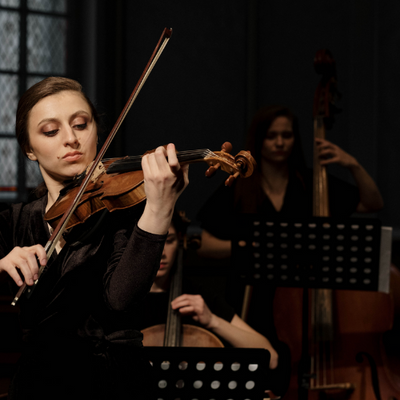
Various types of mutes on the market
Here are some commonly found mutes on the market and their advantages and disadvantages, which can be helpful when making a purchase decision.
1. Round Tourte Mute

Suitable for: Orchestral violinists
The Round Tourte Mute is the most common violin mute known for its simple and practical design. It features a round shape, making it easy to install and adjust. It is placed between the A and D strings and pushed towards the bridge when needed, securing it on top of the bridge.
| Advantages | Disadvantages |
|
- Only affects the volume while having minimal impact on the tone. It is a popular choice among many orchestra violinists. - Affordable. |
- Provides minimal dampening of sound. - May rattle during performance as the vibrations of the strings pass into the tailpiece.
|
2. Shaped Tourte Violin Mute

Suitable for: Orchestral violinists
The mute effect of this mute is relatively smaller compared to the Round Tourte Mute. However, if the price is a consideration, the shaped mute is the most inexpensive option. It is stored by hanging it on one of the violin strings, typically the A or D string, and using it is exactly the same method as the round tourte mute.
| Advantages | Disadvantages |
|
- Very affordable, cheaper than the regular Tourte mute. - Highly flexible, allowing for placement on either the A or D string. |
- Provides less muting effect compared to the Round Tourte Mute. - May rattle during performance as the vibrations of the strings pass into the tailpiece. |
3. Spector Violin Mute

Suitable for: Violinists who require a mute that does not rattle.
The Spector Violin Mute, created by Fred Spector, a violinist with the Chicago Symphony Orchestra, is designed to be easily attached between the A and D strings by pushing them toward the bridge.
| Advantages | Disadvantages |
|
- Very convenient to use, as it can be hung between the A and D strings and easily pushed towards the bridge when needed. - Exquisitely small and discreet, available in colors that can match the instrument, making it less noticeable. - Only affects the volume with minimal impact on the tone. - Even when not in use, it does not rattle during performance.
|
- Hard to remove from the instrument when the player does not require a mute.
|
4. Bech Magnetic Mute

Suitable for: Orchestra or concert violinists, as well as violin teachers.
The Bech Magnetic Mute is equipped with a magnet and comes with a small accessory that can be attached to the tailpiece, allowing the mute to be magnetically secured to it when not in use. The installation method is the same as the Round Tourte Mute.
| Advantages | Disadvantages |
|
- Provides a better muting effect compared to the Spector Violin Mute. - Does not rattle on the tailpiece. |
- Can be quite expensive. |
5. Rubber Claw Style Violin Mute

Suitable for: Violin beginners, children, or violinists who need to practice frequently.
This is a very common violin mute. This mute is sometimes dubbed the ‘hotel mute’ as some travelling violinists that stay in hotels use this mute to reduce their sound projection to avoid disturbing neighbouring guests. It effectively suppresses the vibration of the entire bridge, thereby reducing the overall resonance of the violin. It is directly placed on the bridge.
| Advantages | Disadvantages |
|
- Affordable, typically costing around $5. - Provides a good muting effect. - Has a dramatic impact on the tone, making it much softer. |
- Alters the tone significantly, the instrument might sound weird after using the mute. - Not suitable for solo or performance use. |
6. Metal Claw Style Violin Mute

Suitable for: Adult violin beginners.
This type of mute is made of metal, and different metal compositions will produce different muting effects, with noticeable changes to the tone. Also placed on top of the bridge like the rubber claw mute.
| Advantages | Disadvantages |
|
- Provides an excellent muting effect. - Various styles are available. |
- Heaviest known mute for the instrument. - Possibility of damaging the violin if the mute falls off or breaks off the bridge. - Not suitable for all types of bridges. Improper installation of a metal mute on an incompatible bridge may damage the bridge. - Expensive. - Not suitable for solo or performance use.
|
7. Alpine ‘Menuhin’ Shield Mute


Suitable for: Violinists looking for a good mute without risk of rattling sounds
This mute is an upgrade over the regular Tourte mute, being installed directly onto the D and A strings as well. However, due to its design, the mute is less prone to rattling on the D and A strings during performance when not in use. Usually has a brass piece in the middle and is made with hard plastic.
| Advantages | Disadvantages |
|
- No rattling during performance. - Better muting effect than the Spector or Tourte mutes. |
- Relatively more expensive than the Tourte or Spector mutes. - The brass piece in the center might oxidize. |
8. The Jascha Heifetz Mute


Suitable for: Violinists looking for a good mute with variable effects.
This mute is slightly more rare, it is not commonly used by current violinists. It is T-shaped and stored on the corner of the string when not used. Named in conjunction with Jascha Heifetz who predominantly used it. It comprises a steel core wrapped in rubber. The slightly taller design of the mute enables violinists to achieve 2 different mute effects by either fully pushing the mute all the way down or pushing it halfway down.
| Advantages | Disadvantages |
|
- No rattling during performance. - Better muting effect than the Spector or Tourte mutes. - Variable muting effects to suit the performer.
|
- Relatively more expensive than the Tourte or Spector mutes. - Considerably small and thin, slightly awkward to use in performance settings where the music requires the performer to put on a mute very quickly.
|
9. Roth-Sihon Mute


Suitable for: Violin students looking for a light mute that doesn’t considerably affect tone.
This violin mute was made by Roth-Sihon in Germany, at an undetermined date. It is a slide-on style mute, made of metal wire and rubber. The mute is placed on the D and A strings by ‘hooking’ each corner of the mute into the strings. The mute is pushed onto the bridge like a Spector mute to be used.
| Advantages | Disadvantages |
|
- No rattling during performance. - Very lightweight and secure on the instrument. |
- Weak muting effect. - The rubber portion may collect dirt after a while. |
How to choose a suitable mute for yourself?
Choose a mute based on your playing needs, which can be categorized into practice or performance. For practice sessions, one can use the Rubber ‘Claw-Style’ Violin Mute. For performance, options like the Round Tourte Mute, Spector Violin Mute or Alpine Shield Mute are usually the most popular choices for orchestral violinists.
Then again, as professionals, one must consider the desired level of muting effect. Since mutes suppress vibrations from the string into the instrument, one must be careful to use a mute that does not affect the instrument’s tone and sound after usage. The rubber ‘claw’ mutes often cause a violin to vibrate far less than it usually does, and taking it off may result in the violin sounding more strident than it normally sounds.
The Jascha Heifetz Mute is an example of what a good mute looks like, affording the player varying levels of muting effects due to its design. This mute can be used for most solo performances so the soloist can play with varying effects to their advantage.
Lastly, take age into account. Some mutes, such as the Spector Violin Mute, may not be suitable for smaller violins. Similarly, the Metal Claw Style Violin Mute might be too heavy for young children. If you are a professional violinist, it is best to select a mute based on your personal preference and playing style.